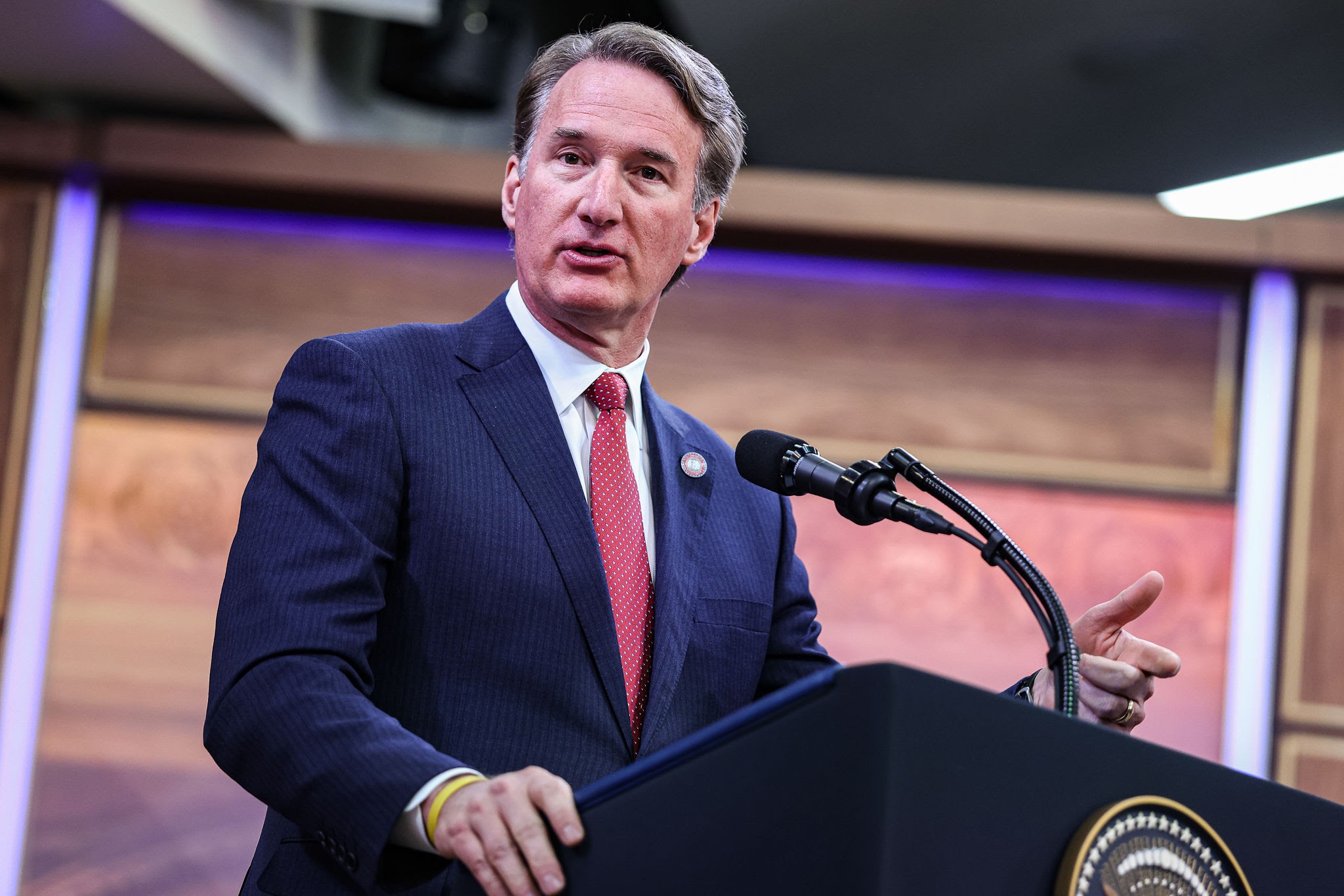
Former governor argues constitutional process violations with 10 days before statewide referendum.
By Marcus Webb | The Commonwealth Wire
Former Gov. Glenn Youngkin called on the Supreme Court of Virginia Saturday to strike down the upcoming redistricting referendum, arguing the constitutional amendment stems from an unconstitutional legislative process.
Speaking to more than 150 supporters at a Richmond-area campaign event, Youngkin urged the court to block the Nov. 5 statewide vote on Constitutional Amendment 1, which would transfer redistricting authority from the General Assembly to a bipartisan commission.
“This amendment was born from a flawed process that violated our state constitution,” Youngkin said during the Saturday afternoon rally. “Virginians deserve better than a rushed measure that undermines our democratic institutions.”
The proposed amendment would create a 16-member commission with equal representation from both major political parties to draw legislative and congressional district maps following each census. Currently, the General Assembly holds redistricting authority, though courts have intervened when maps were deemed unconstitutional.
Youngkin’s legal challenge centers on procedural requirements for constitutional amendments in Virginia. The state constitution requires proposed amendments to pass identical versions in two successive General Assembly sessions before reaching voters. Youngkin’s team argues technical differences between the 2023 and 2024 versions invalidate the referendum.
“The General Assembly failed to follow the precise constitutional requirements,” said campaign spokesperson Sarah Mitchell. “These aren’t minor clerical errors – they’re fundamental procedural violations.”
Supporters of the amendment dismiss Youngkin’s challenge as a last-minute attempt to preserve partisan advantage in redistricting. The Virginia Redistricting Commission Coalition, which backs the measure, maintains the legislative process met all constitutional standards.
“This is a desperate move to keep politicians drawing their own districts,” said coalition director David Chen. “Virginia voters deserve the right to decide whether they want nonpartisan redistricting.”
The Supreme Court of Virginia has not indicated whether it will hear Youngkin’s petition before the election. Legal experts note the high court rarely intervenes in election matters so close to voting dates without compelling constitutional grounds.
Recent polling shows Virginia voters narrowly support the redistricting amendment, with 48% in favor and 42% opposed, according to a Christopher Newport University survey released last week. The remaining 10% remain undecided.
The redistricting debate has drawn significant attention from national political organizations. Good government groups have invested heavily in promoting the amendment, while some Republican organizations have funded opposition efforts.
Voters will decide the amendment’s fate alongside races for all 140 General Assembly seats on Nov. 5. Early voting is already underway at registrar offices across Virginia’s 95 counties and 38 independent cities.
The amendment requires a simple majority to pass. If approved, the new redistricting commission would first convene after the 2030 census to draw maps for the 2031 elections.
Key Facts
- Youngkin argues the redistricting amendment stems from constitutional process violations in the General Assembly
- The amendment would transfer redistricting authority from lawmakers to a 16-member bipartisan commission
- Recent polling shows 48% of Virginia voters support the measure, 42% oppose
- The Supreme Court of Virginia has not indicated whether it will hear the challenge before Nov. 5
- Early voting is currently underway across Virginia’s 95 counties and 38 independent cities